Log in


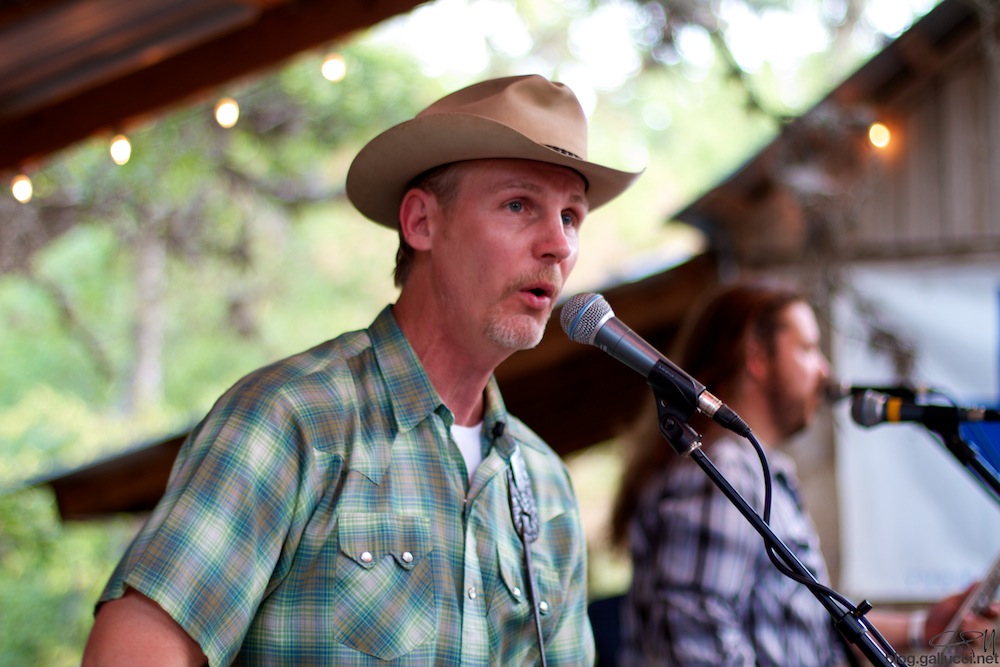
This is Newport Folk Festival weekend, so I won’t be around for the comments here until later. Next week will be the recap of the festival. As I didn’t have a lot of time in Chile for writing these posts, I still had one show from May that I had not discussed. When I went to see my brother in Texas in May, I saw that Max Stalling was playing at Dan’s Silver Leaf in Denton. Now, Dan’s is one of those great places that is everything good about Texas. It basically hasn’t changed in 20 years either. It’s still the home of cheap beer, smoking on the patio, and the best singer-songwriter Texan music that exists. I saw James McMurtry there. I saw Dale Watson there. I saw Turnpike Troubadours there when they were just another semi-popular Texas band. Enough of this type of artist still rises up too that it’s not just ancient singers holding on like at a lot of folk spaces. Max Stalling is just one of those guys who is a big deal in Texas and almost totally unknown outside of it, a very fine singer and songwriter making damned fine country music, in tandem with his wife Heather on fiddle and a quite good band. The opener was super fun too, Matt Hillyer, the singer of Eleven Hundred Springs, almost the prototypical Texas band that never made it outside of Texas but played forever inside the state. A show like that, it’s basically the best of what Texas offers to the world.
Other News:
I’ve seen a few music documentaries recently worth discussing. I have never been a fan of Brian Eno or his work or that whole scene, but I didn’t regret watching Gary Hustwit’s recent documentary on him. The documentary is called a “generative documentary” in that some of the film changes each time you watch it based on a random number generator. This seems incredibly dumb to me though evidently it really does take several viewings to see most of the scenes. Once seems enough for my purposes. But I guess it represents a kind of spirit of Eno messing around with electronics and in fact, he wanted the film this way because of course he did. What’s more interesting about the film to me is the inability by Eno or Bowie or anyone else to describe exactly what it is that Eno ever did. He’s just kind of a spirit or a house intellectual. He doesn’t really play a lot and certainly never played a lot of notes when he did. But who could possibly overstate his influence on culture in the last 50 years? He’s an interesting guy, if nothing else. And for me, really it doesn’t go too far beyond that.
I also watched This Ain’t No Mouse Music, the 2013 Maureen Gosling & Chris Simon documentary about Arhoolie Records founder Chris Strachwitz, who was one of these massive American folk music obsessives from the early 60s who decided he needed to record everyone he could and save all this old culture. A German immigrant, he brings a certain sense of, er, purity culture to it all. Yeah, he festishized the fuck out of American folkways. But he also found Mance Lipscomb and Lightnin’ Hopkins, did an enormous amount of work to save old conjunto records from the border region, helped make relative stars of Clifton Chenier and Flaco Jimenez, I mean you take him being a total crank for all this. And he was definitely a total crank and pretty clearly a gigantic asshole when he didn’t get his way, the film doesn’t even pretend to hide this. Of course, lots of commentary from other musicians about him in the film.
Finally, I watched Kavery Dutta Kaul’s 1988 film One Hand Don’t Clap, about the calypso scene in Trinidad, mostly around Lord Kitchener but also some around Calypso Rose. It’s alright as a film. I’m not a huge calypso guy and the material on the socio/cultural side of all this is a bit more marginal to it than I’d like, so I’d say this is basically OK, with some good footage and some spirited performances. But it’s really better for active fans of the music than your more casual viewer, like me.
Joe Melson, Roy Orbison’s songwriting partner who cowrote “Only the Lonely,” among other songs, died at 91. That’s kind of the perfect song.
If you are a Gen X person and want to feel real old, Dave Kendall, host of 120 Minutes, died at 63. Also, I confess that I never had really thought about the musicians behind “The Pink Panther” soundtrack, other than Henry Mancini of course, but Plas Johnson, who played the iconic saxophone for it, died at 94.
So this is pretty cool–the entirely of shows I have been to being released as a live recording is one William Parker song off The Peach Orchard. But now, the Joel Harrison-led version of In a Silent Way from Big Ears 2025 has been released on Bandcamp. My God this was a great show, one of the all-time highlights of live shows in my life. So I am glad to be able to buy it!
This week’s playlist:
- Brandi Carlisle, The Firewatcher’s Daughter
- Palace Brothers, There Is No-One What Would Take Care of You
- Joe Ely, Live at Liberty Lunch
- Emily Scott Robinson, Appalachia
- Margo Price, All American Made
- Nicholas Hodges/Fred Sherry/London Symphony Orchestra, The Music of Elliott Carter, Vol. 7
- Quantic/Alice Russell, Look Around the Corner
- S.G. Goodman, Planting by the Signs
- Nico Segal, Surf
- Mourn, Self Worth
- Loretta Lynn, Van Lear Rose
- Harriet Tubman/Georgia Anne Muldrow, Electrical Field of Love
- Priests, Bodies and Control and Money and Power
- Buddy and Julie Miller, In the Throes
- Charlotte Gainsbourg, IRM
- Sharon Van Etten and the Attachment Theory, self-titled
- Whitney Rose, Rosie
- Max Roach, We Insist! The Freedom Now Suite
- Neil Young, Hitchhiker
- Dave Rawlings Machine, Nashville Obsolete
- Leonard Cohen, Ten New Songs
- Jim & Jennie & The Pinetops, One More in the Cabin
- Missy Raines & Allegheny, Love & Trouble
- The Alan Lomax Collection, Vol. 1
- Charlie Rich, Behind Closed Doors
- Jose Gonzalez, Veneer
- Tropical Fuck Storm, Brain Drops
- Empress Of, I’m Your Empress Of
- Sun Mi-Hong, Fourth Page: Meaning of a Nest
- Django Reinhardt, Djangology 49
- McCoy Tyner, Together
- Buddy Tabor, Writing on Stone
- Led Zeppelin, IV
- Ken Pomeroy, Cruel Joke
- Tom T. Hall, The Storyteller
- Mitski, Laurel Hell
- Stevie Wonder, Songs in the Key of Life, disc 1
- John Coltrane, Giant Steps
- Bill Frisell, Floratone
- Dave, Psychodrama
- Chris Stapleton, Traveller
- Hank Thompson, Seven Decades
- Lorelle Meets the Obsolete, De Facto
- Loudon Wainwright III, Unrequited
- Eric Taylor, self-titled
- Sunny Sweeney, Trophy
- Christopher Paul Stelling, Itinerant Arias
- Gary Stewart, The Essential
- Bonnie Prince Billy, We Are Together Again
- Bobby Bare, The Winner and Other Losers
- Merle Haggard & Bonnie Owens, Just Between the Two of Us
Album Reviews, something of a Newport Folk Festival prep week for me:
Feeble Little Horse, Bitknot
I’m not going to make any huge claims that this Pittsburgh band is a great rock outfit exactly but I do like them quite a bit. Lydia Slocum is a very good vocalist and I do like the juxtaposition between the often singer-songwriter through shoegaze sort of vocals and the very loud rock and roll sound between them. I guess you could say the same thing about MJ Lenderman, who is the prince of indie rock these days, even though I don’t really think he deserves that title. Girl With Fish really got me as the type of rock album I like a lot. Bitknot, the new album, ain’t bad either. The sound is heavier here, which raises the contrast with the vocals. Sometimes, I wish the vocals could match that intensity. The theme: it sucks to be in your 20s. These days, it’s hard to argue with that, not with the horrors the internet and AI have unleashed on the world, subjects of these songs. Ain’t much better in your 50s though, so at least they have that to look forward to.
B
Mavis Staples, Sad and Beautiful World
Any new Mavis Staples album is a treasure. Her voice isn’t what it was 50 years ago, but whose is? She’s still a force and one of the things I treasure her for is her mentorship of young musicians. She is all over Newport Folk, even if she isn’t on the schedule. Last year, I saw her come out and play with Lucius because of course she did. Can you imagine Mavis Staples wanting to sing with you? Must be amazing. Anyway, she doesn’t hide herself away like lot of older musicians or just ignore the present. She doesn’t have some belief that her heyday was the best. She knows that there’s great music now just as there was then and she wants to be part of that.
So one of the really nice things about her new album is that she has great tastes in songs that aren’t just covering another Dylan tune. She starts here totally reworking the Tom Waits song “Chicago.” And then she goes right into a touching version of Kevin Morby’s “Beautiful Strangers,” which is a very nice song both here and on Morby’s album, about gun violence. There’s covers of Sparklehorse’s “Sad and Beautiful World, ” Gillian Welch’s “Hard Times,” Curtis Mayfield’s “We Got to Have Peace,” and then Eddie Hinton’s “Everybody Needs Love” to close the album, a song that got revived by the Drive-By Truckers about 15 years ago. There’s also a new track written by Hozier and Alison Russell. Staples basically rethinks the idea of the Great American Songbook to realize that there are great songs written in the past but there are just as many great songs written today. The band, which includes MJ Lenderman and hosts of other first rate and mostly youngish musicians, is first rate. It’s like the spirit of Newport Folk in one album by one of the greatest artists to ever sing in this nation. Also, good for her to recognize that the old songs are not better than the new songs, and this from a woman who not only loved Dylan’s music but who had a marriage proposal from Bob.
A-
Altun Gün, Garip
I ran across one of this Turkish band based in Amsterdam’s album last year and loved its rock-psych-garage Turkish feel. So when I saw there was a new album, I had to hear it. Turns out it’s pretty damn good! I don’t know that there’s really any big difference than their previous work, but, well, I will say this: I would absolutely prioritze the hell out of seeing this band at Big Ears if there’s any way to make that happen.
A-
Ambrose Akinmusire/Mary Halvorson, Slo-Mo Luminate Hoverings
Akinmusire and Halvorson are two of the real geniuses of contemporary jazz. This is project they’ve worked on for years. Is it OK to say that I don’t find it overly enjoyable? Yeah, it is. It comes down to much of the problem with a lot of duet jazz albums, which is that there’s not much to hold onto except for their rather occasional notes. For me, this is the kind of jazz that feels like an art project more than an album, not because they aren’t great at what they do. They obviously are, the technical skill is obvious. It’s because I just don’t much care to listen this sort of slowish album unless it manages to touch me in some way and this never quite gets there for me, with the exception of the last track on the album, which I thought quite powerful. It’s all good, they both have albums I love and I can listen to those.
B–
Billy Bragg, The Roaring Forty, 1983-2023
Bragg isn’t playing at Newport this year, but the one time I saw him was at Newport, two years ago. My general impression of him, both live and what recordings I’ve heard, is that I like him more in principle than in fact, as agitprop as songwriting can only go so far. So I like the idea of listening to his 40th anniversary collection, which is 40 songs, to set my thoughts on a stronger foundation. I have a few. First, no one should listen to this much Billy Bragg at one time. Second, he sure has grown as a vocalist over the years. His early tracks–many of which include his best songs, such as “St. Swithin’s Day” are pretty rough, which makes sense since his roots are in punk, but the solo voice with electric guitar didn’t always serve him that well. Third, his best songs really are great. Fourth, I never need to hear that version of “The Internationale” again. Or any version, for that matter. Fifth, he has a great knack for writing a political song overnight, but they don’t always hold up. Sixth, he sounds so good with Wilco backing him up on the Mermaid Avenue tracks, most of which are included here. Bragg is in the end not a great artist, but I am glad he is out there. I just need to hear a track now and then rather than whole albums.
B+
Lone Justice, Viva Lone Justice
The early 80s LA scene was incredibly fertile–X, The Blasters, Los Lobos, Concrete Blonde, Dwight Yoakam, Tom Waits as older but still around, all these people were hanging out and learning from each other. One of the greatest, if short-lived, bands from this scene was Lone Justice, the early alt-country outfit helmed by Maria McKee, who would go on to have a good, if not transcendent, solo career. I picked up an EP of there’s called The Western Tapes, which is 20 minutes long and which has become one of most listened to albums. In 2024, the band went back and put this release together from old material updated with some modern dubs. It shows what a band this could have been had Geffen not ruined them, a classic tale of a major label fucking up something great. At times, she sounds like Exene, other times you are hearing fiddle tunes. There’s also a refreshing lack of the brittle 80s production values that were so terrible for bands like this (seriously, of every rootsy/songwriting artist or band who started in the 60s and 70s, who was actually putting out good material in the 80s, other than Richard Thompson? It’s grim). The wide variety of styles here means it doesn’t quite cohere as a great album might, but it’s certainly a fun listen at the least. Plus she has the balls to cover “I Will Always Love You” and does a pretty good job of it because she doesn’t try to hit that Dolly/Whitney high note AND follows it directly with MC5s “Sister Anne.” How can you not love that?
A-
Hayley Williams, Ego Death at a Bachelorette Party
I like Hayley Williams and her old band Paramore just fine. Why she is closing the Friday set at Newport it an interesting question. By the time this post is published, I will have already decided whether to deal with the traffic jam at the end of the day in order to see this. Probably I won’t. I wouldn’t mind seeing her at all, but you have to then get home like 3 hours later than you would otherwise. It’s a big commitment.
I have little interest in hashing out the meaning of “folk music” in 2026 and Newport has long ago put away Bob Dylan and Joan Baez. So in 2026, I guess Hayley Williams closes a day here because anyone who writes their own songs and plays a guitar is “folk” music. Well, so be it, I suppose.I will say one thing where this makes sense–Williams is a very good songwriter. The title track, about “I’m the biggest star at this racist country singer’s bar/No use shootin’ for the moon, no use chasing waterfalls” is pretty great. The following track, “Hard” is a banger as well. Why can’t folk music be completely contemporary with contemporary production anyway? Don’t ask Chris Strachwitz that though.
B+
As always, this is an open thread for all things music and art and none things politics.
The post Music Notes appeared first on Lawyers, Guns & Money.