I need to channel my hero, Andy Rooney, here. Maybe I need to make a series of this. For context, the greatest moment in the history of the grave series is after I visited Andy Rooney and his son emailed me and said his father would have enjoyed drinking bourbon with me. I assured him the feeling was mutual!
So….why does pico de gallo exist? I was getting a beer tonight at a local brewery with the wife. We ordered the chips and “salsa.” But in fact, it is not salsa. It is pico de gallo, which is turns out is what is listed below where it says salsa, except in tiny print.
Why does this exist? Has anyone ever been like, I really need some chopped vegetables on my chips, most of which will fall off, possibly onto my clothing? What exactly does pico de gallo offer that salsa does not? Is it as tasty as salsa? No. Does it have the depth of a flavor as a good salsa, or even a storebought whatever salsa? It does not. Does it actual stay on the fucking chips? No. Who even thought of this? Evidently, it is from Sonora, which explains it, as northern Mexico is not exactly the center of Mexican cuisine. I guess that in Sonora, it often includes chili powder that is not used in the U.S. That would help. Or you could just use a salsa like everywhere else in Mexico.
In any case, pico de gallo is a massively overrated food and should not be on menus.
It’s a term of art in programming: the actual elapsed time on the clock on the wall, as opposed to CPU time or token throughput or any other measure of what the machine is doing internally.
I hadn’t come across it before, despite having spent years thinking about time and technology, and it lodged in my head.
The interesting thing there for me about AI agents isn’t just how much they can do, it’s the growing gap between the machine’s time and the human’s time.
An agent can burn through a hundred million tokens in a day. The wall-clock time for the human supervising it is the same twenty-four hours it always was.
And then the BCG/HBR AI brain fry study landed earlier this month. Workers who oversee multiple AI agents report 33% more decision fatigue, 39% more errors, and a distinctive “buzzing” sensation, a mental fog that participants struggled to name until the researchers gave them one – “Brain Fry”. 14% percent of AI-using workers report this brain fry. In marketing, it’s 26%.
Steve Yegge, who’s been building Gas Town: a multi-agent orchestrator for managing colonies of 20+ parallel AI coding agents – wrote about the same phenomenon a few weeks earlier, in a post he called “The AI Vampire.”
His framing was vivid: AI makes you 10x more productive, but the productivity comes at a cost the industry hasn’t named yet. Yegge described sudden “nap attacks”: collapsing into sleep at odd hours after long vibe-coding sessions — and observed that friends at other AI-native startups were reporting the same thing.
His image was Colin Robinson from What We Do in the Shadows: an energy vampire, sitting on your shoulder, drinking while you (it? both?) code.
The work is exhilarating and draining, simultaneously, because AI automates the easy parts and leaves you with an unbroken stream of hard decisions compressed into the same number of hours.
Both accounts are being framed, mostly, as a UX problem (better dashboards), a training problem (up-skill your people), or a management problem (set limits). All valid?
But it seems to me that something else is going on — something older and more structural — and it has to do with clocks.
But the brain fry study has maybe sharpened something for me.
E.P. Thompson’s “Time, Work-Discipline, and Industrial Capitalism” (1967) is the essential starting point. His argument: clock-time is not a natural given. It’s a technology, imposed by the factory system.
Pre-industrial societies worked to task-time — you milked the cow when the cow needed milking, you fished when the tide was right. The mechanical clock and the factory bell imposed a different regime: synchronised, disciplinary, abstract. And crucially, it wasn’t just imposed from above: it was internalised, through schooling, religion, print culture, until it felt like common sense.
James Carey showed how the telegraph extended this further — it could transmit time faster than a train could carry it, which is how we ended up with standardised time zones. The telegraph didn’t just speed up communication; it made wall-clock time universal. And then came the step that I think matters most for where we are now.
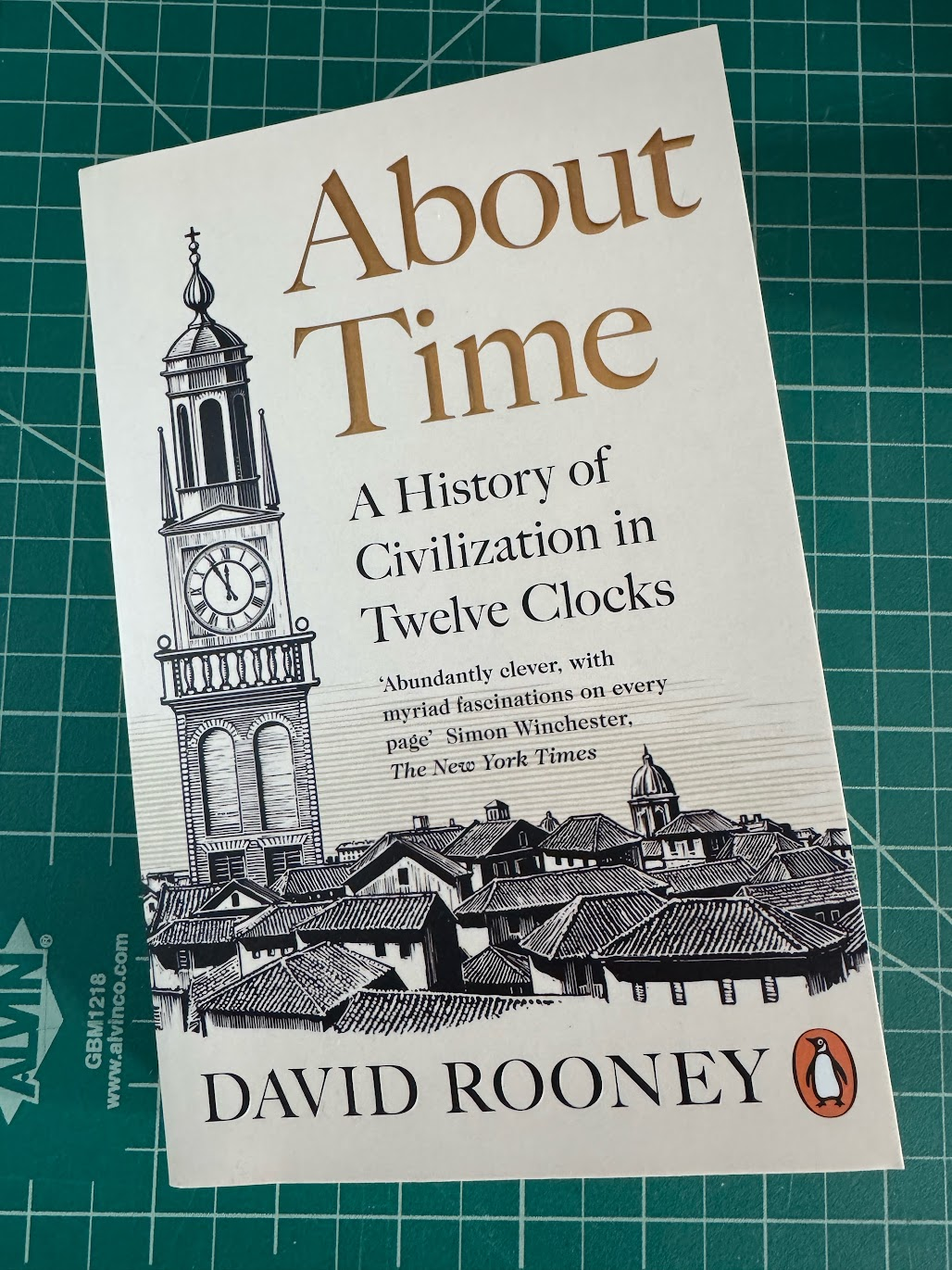
David Rooney’s About Time traces what happened when precise, synchronised time could be distributed electrically — wired clocks in factories, schools, railway stations, town squares. The Brno electric time system of 1903 is his case study.
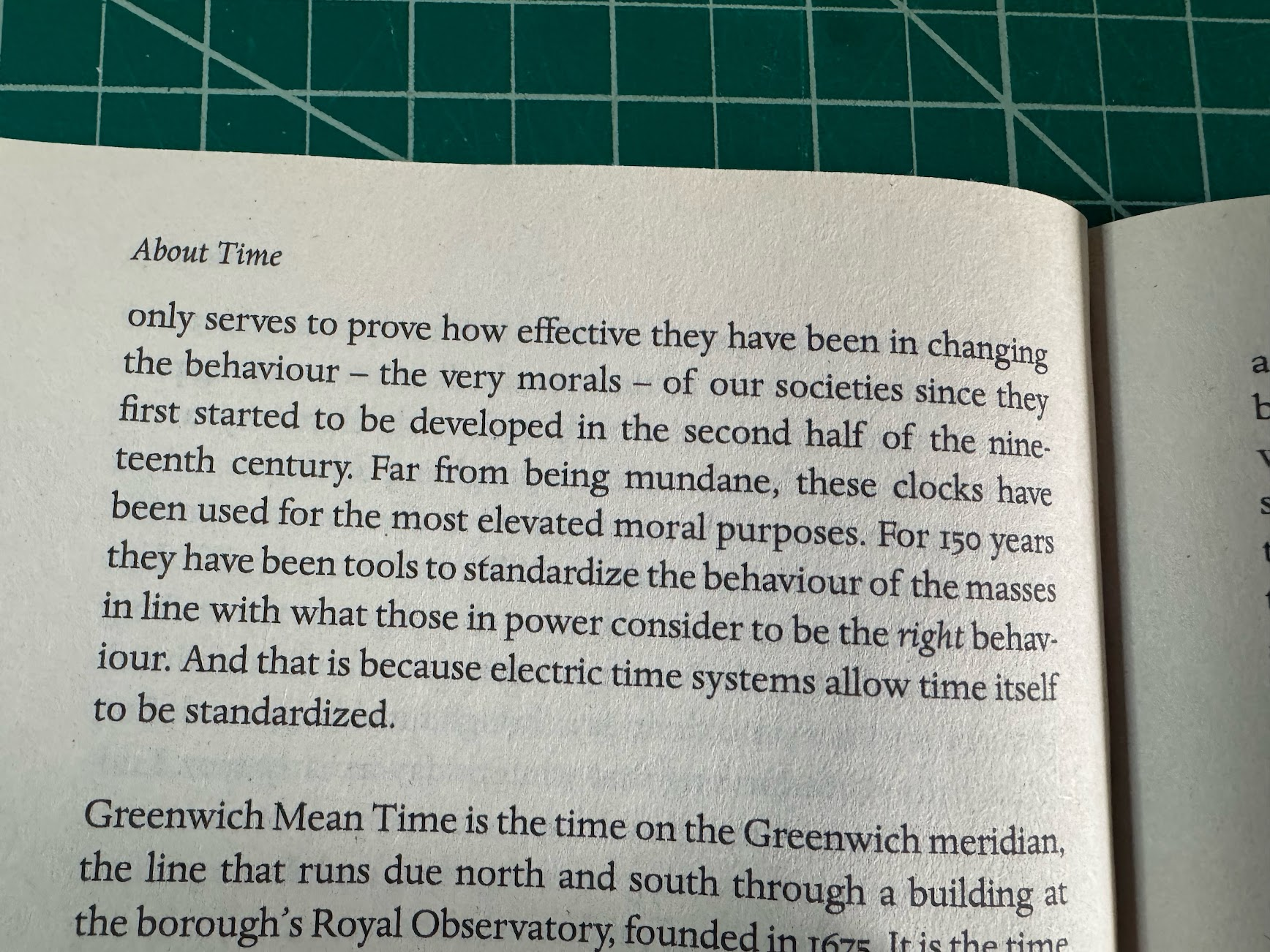
Once the infrastructure existed to push accurate time into every public space, clock-discipline stopped being merely an economic requirement and became a moral one.
Punctuality became a virtue. Being on time was being a good citizen, a reliable worker, a decent person. The machinery of timekeeping was internalised so completely that it ceased to look like machinery at all — it looked like character. Electric time could be exported across the industrialised world not just as coordination but as morality.
Carolyn Marvin, in When Old Technologies Were New (1988), demonstrated the same pattern from a different angle: every new medium — telephone, electric light, radio — was received as “new” precisely to the extent that it seemed to annihilate time and distance.
The rhetoric is remarkably consistent across eras.
We’ve been having the same conversation about technology conquering time for about a hundred and fifty years.
So wall-clock time — the time of schedules, meetings, train timetables — was already a technological imposition on older, bodily rhythms.
It’s not the “natural” baseline against which AI’s speed is measured. It’s just the previous generation’s machine. And — per Rooney — it’s not just a machine. It’s a machine that learned to dress up as a moral principle.
But something has shifted.
Félix Guattari distinguished between human time and machinic time: the former mediated by clocks and institutions, the latter operating at computational speeds that exceed human perception entirely. Hartmut Rosa calls it the “shrinking of the present” — the window in which your past experience reliably predicts the future gets narrower with each acceleration. And Paul Virilio spent decades developing what he called dromology — from the Greek dromos, a racetrack — essentially a science of speed.
His argument was that the history of civilisation is not primarily a history of wealth or territory but of velocity: who controls the fastest, densest barrage controls the territory. Each new speed technology — the stirrup, the railway, the telegraph, the missile, the fibre-optic cable — reshapes not just logistics but perception itself.
Speed doesn’t just let you move more easily; it changes what you can see, hear, and think. Push acceleration far enough and you get what Virilio called the “aesthetics of disappearance” — things moving too fast to be perceived at all. The landscape seen from a bullet train isn’t a landscape anymore; it’s a blur. The high-frequency trade executed in microseconds isn’t a decision anymore; it’s a reflex of infrastructure.
The BCG study’s “buzzing” and “mental fog” sit right in this lineage. Railway passengers in the 1840s reported nervous exhaustion at 30mph — what doctors called “railway spine.”
Schivelbusch documented how rail speed literally rewired perception: landscapes became panoramic blurs, attention fragmented, a new kind of fatigue emerged that the medical establishment had no language for. Telegraph operators developed what we’d now recognise as burnout. The body protesting a tempo it didn’t choose.
So maybe, brain fry is the 2026 version of railway spine?
I.E. an embodied protest of a nervous system being asked to run at a tempo it didn’t evolve for.
Brain Fry & Bullet Hell
This came to mind when I was trying to describe the feeling of supervising multiple AI agents to a friend: the way you end up in a state of continuous partial attention, scanning outputs, waiting for something to go wrong, never quite able to look away and I realised the closest analogy I had was danmaku.
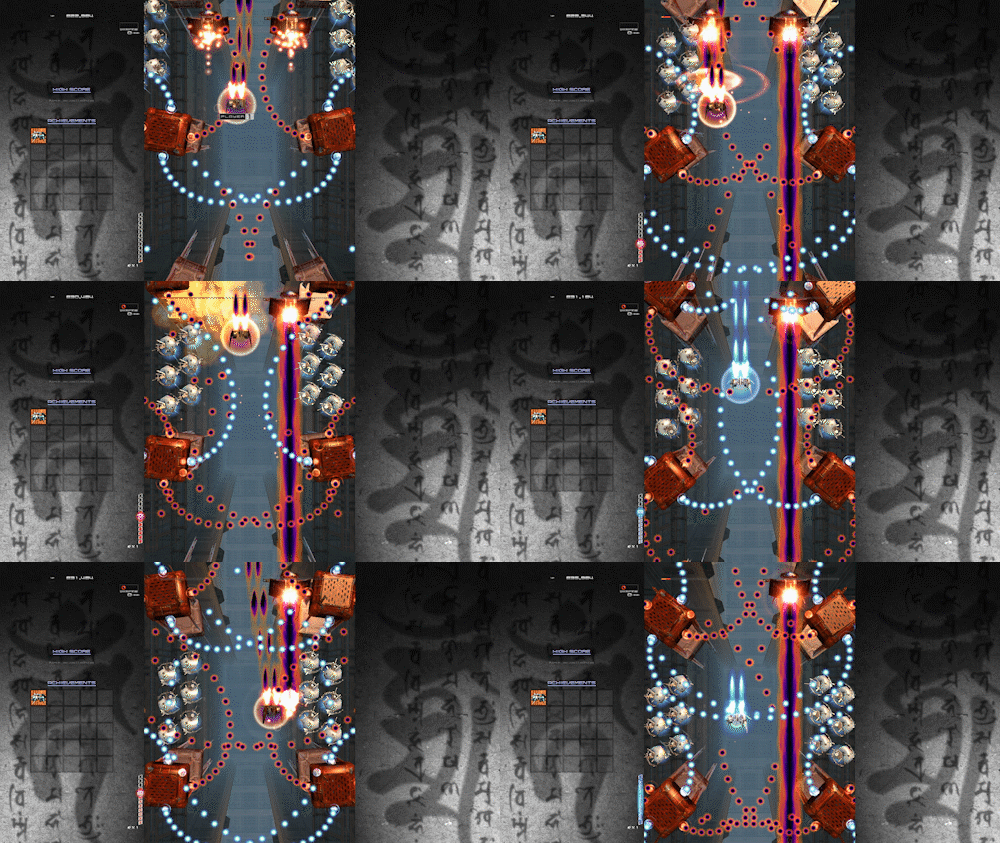
For those who haven’t encountered it: danmaku (弾幕, literally “bullet curtain”) is a Japanese arcade genre — sometimes called “bullet hell” — where the screen fills with hundreds of projectiles in elaborate, spiralling patterns. The player’s ship is tiny. The bullets are everywhere. The whole point is overwhelm. Games like Touhou, DoDonPachi, Ikaruga.
Beautiful, punishing, compulsive.
I think Ikaruga was my introduction to them.
Ikaruga
In danmaku, information throughput exceeds conscious processing — you literally cannot track each bullet individually.
The BCG finding that cognitive load spikes after three AI tools describes the same saturation point: too many concurrent streams of machine-speed output for a single human to monitor serially.
Touhou
But – expert danmaku players don’t get faster. They change how they see.
They shift from focused attention (tracking individual bullets) to a kind of peripheral soft-focus — reading patterns, finding the safe channel through the barrage. It’s a perceptual shift, not a speed upgrade. And it leads, reliably, to flow states. Csikszentmihalyi’s sweet spot: challenge meets skill, self-consciousness dissolves, time distorts in the good way. Players describe it as exhilarating.
So: a human being synchronises their nervous system to machinic time, processes hundreds of parallel streams of machine-speed output, and the result is exhilaration.
Meanwhile, another human being supervises three AI agents producing parallel text outputs at roughly the same structural tempo, and the result is brain fry.
Same physics. Opposite feeling.
I think 3 things account for that gap.
First, consent. The danmaku player chooses the machine’s tempo. That’s the game — you opt in. The knowledge worker has it imposed by a productivity mandate. Thompson again: the difference between dancing and marching is who sets the beat. The factory bell and the AI agent notification are structurally identical — both impose a rhythm from outside the body. One is discipline, the other is play, depending entirely on the power relationship.
Second, legibility. Bullets are unambiguous. A bullet is a threat, a gap is safety, the feedback loop is instant and total. AI agent output requires continuous evaluative judgment — is this correct? relevant? hallucinated? — which loads a different, slower cognitive system on top of the tracking task. You’re playing bullet hell, except some of the bullets might be power-ups, but you can’t tell until you stop and read them carefully. Which rather defeats the purpose of the soft-focus.
Third, reversibility. Die in danmaku, you lose a life and restart. The stakes are emotional, not consequential. If I miss a sloppy AI output — a hallucinated fact, a wrong number, an email sent with your name on it — the damage is real, IRL. The fear of consequential failure however small prevents exactly the relaxed alertness that flow requires.
An excursion to The Bullet Farm
There’s an etymological thing here that I find quite evocative.
弾幕 — danmaku — starts as a military term.
A barrage. Suppressive fire. The purpose isn’t to hit specific targets but to make an entire zone impassable.
The word migrates to arcade games in the 1990s, where the screen becomes the impassable zone.
Then it migrates again to Niconico Douga in the 2000s, where it describes the dense scrolling comment overlays that cover the video — thousands of viewer comments streaming across simultaneously. A curtain of text.
Three instances of the same image: a barrage of projectiles, a barrage of pixels, a barrage of words.
One of three warlords controlling essential resources in a post-apocalyptic economy — water, fuel, ammunition.
His power isn’t that he uses the bullets; it’s that he controls their supply. He doesn’t need to aim. He just needs to fill the zone. Dromology again: whoever controls the fastest, densest barrage controls the territory.
It’s not lost on me that Yegge named his multi-agent orchestrator after the Fury Road settlement. Gas Town — the place that refines and distributes fuel.
In Miller’s economy, Gas Town, the Bullet Farm, and the Citadel form a tripartite monopoly on the resources that make movement, violence, and survival possible.
Yegge’s Gas Town manages the fuel supply for AI coding agents — the orchestration layer that keeps the colony of twenty-plus agents running. But the Bullet Farm is maybe the bit nobody’s building yet: the thing that manages the barrage of outputs those agents produce, and the human attention required to survive it.
Think about this in relation to the AI landscape more broadly. The competitive advantage isn’t in any single agent’s output quality — it’s in the sheer volume and speed of the barrage. Flood the workspace with tools, agents, copilots. The worker, like Furiosa, has to find a path through it.
So the word carries four registers: military (suppress movement), ludic (overwhelm as play), communal (overwhelm as shared experience), and political-economic (overwhelm as resource monopoly). Each preserves the core logic — the barrage as design feature, not failure — but the human’s relationship to it changes completely depending on context.
And AI agent oversight is arguably the first context where the barrage is accidental.
Nobody designed multi-agent workflows to feel like bullet hell.
And yet.
The design problem this reveals
If brain fry is a clock problem — a temporal mismatch between human cognition and machinic speed — then solutions that only address interface design or training will help at the margins but miss the structural issue.
Just as telling 1840s railway passengers to “get used to it” didn’t prevent nervous illness.
The danmaku analogy suggests a different set of questions.
If we want AI agent work to feel more like flow and less like fry, the challenge isn’t making things faster or even slower — it’s about legibility, consent, and reversibility, and all three matter at once.
Legibility first: can agent outputs be designed to be scannable as patterns rather than read as individual documents?
Not better summaries — actual visual or structural affordances that let you soft-focus and spot the anomaly, the way a danmaku player spots the gap in the curtain.
Something closer to a radar screen than a text feed.
Then consent: can workers set their own review tempo? Asynchronous handoffs rather than real-time monitoring. What Sarah Sharma calls “temporal sovereignty” — the right to set your own pace.
The BCG data shows that AI reduces burnout when it offloads repetitive work and increases it when it demands oversight. The variable is who controls the clock.
And reversibility: can we lower the stakes of missing something?
Undo, rollback, draft-before-send, human-in-the-loop-but-not-human-as-the-loop. If the consequence of missing a bad output is catastrophic, the nervous system clenches into hypervigilance.
If it’s recoverable, the nervous system can relax into the peripheral awareness that actually works better for this kind of monitoring.
Maybe there’s a hybrid of Braid and git that we need.
I keep coming back to Marvin’s insight that technologies are not fixed natural objects but “constructed complexes of habits, beliefs, and procedures embedded in elaborate cultural codes.” The temporal regime of multi-agent AI work isn’t inevitable — it’s being constructed right now, through design choices and management practices and vendor incentives and labour relations. And — this is the Rooney point again — it’s already being moralised.
Not using AI is starting to be framed as if it’s professional negligence. Not keeping up with the agents feels like a personal failing, not a structural mismatch. The Brno electric clock trick is happening again: a new tempo imposed by infrastructure, dressed up as character.
Punctuality was the virtue of the electric age; throughput is the virtue of the agentic one.
Humanity’s final keyboard, source unknown via Ben Mathes
We’ve been here before.
The factory bell, the railway timetable, the telegraph wire, the always-on smartphone — each imposed a new temporal discipline, each produced its own characteristic form of exhaustion, and each was eventually (partially, imperfectly) domesticated through a combination of regulation, design, and collective action.
The question is whether we can do that faster this time.
Or whether — per Rosa’s paradox — acceleration makes the process of adapting to acceleration itself harder. I suspect it’s the latter, but I’d quite like to be wrong.
Let’s see.
Some of the thinking here draws on Thompson, Schivelbusch, Carey, Marvin, Rooney, Virilio, Rosa, Guattari, Crary, and Sharma — a bibliography of people who’ve been worrying about what machines do to time for rather longer than the current AI discourse might suggest. The BCG/HBR brain fry study is by Bedard, Kropp, Hsu, Karaman, Hawes, and Kellerman. Steve Yegge’s “The AI Vampire” and Gas Town are essential reading on the lived experience of multi-agent orchestration.
Colophon: how this was made
It would be dishonest not to mention this, given what the post is about.
Azeem’s piece — the one that started this — was partly authored by his AI agent. So here we are: an agent-assisted post about agent-assisted posts about the experience of working with agents.
Turtles all the way down, etc.
This piece was written with Claude, over the course of a single session. The process went roughly like this: I had a cluster of half-connected thoughts — Azeem’s “wall-clock time” phrase, the BCG brain fry study, Yegge’s AI Vampire, a memory of Carolyn Marvin, the danmaku thing that occurred to me while trying to explain what agent-wrangling feels like, and a book on my shelf I’d been meaning to think harder about (Rooney). I knew there was a thread running through them but I hadn’t pulled it taut.
What Claude did, in machinic time, was the research legwork: finding and synthesising the Thompson-Carey-Virilio-Rosa-Guattari lineage, pulling together the BCG study’s specific data points, confirming citations, searching for connections I suspected existed but hadn’t verified. It produced structured research notes, then a set of blog post ideas, then a draft. Each round took minutes of wall-clock time and involved the kind of parallel literature review that would have taken me days of reading and note-taking.
What I did, in human time, was something different.
I provided the initial constellation of ideas — the specific intellectual connections that felt interesting rather than merely logical. I pushed back on structure and emphasis. I said “does danmaku connect to this?” and “there’s a Bullet Farm in Mad Max” and “what about Rooney’s electric time as morality?” — the sideways moves, the half-remembered things that might or might not be relevant. Honestly at points I felt like a court jester or the class clown in the seminar. I also read drafts with my own sense of voice and rhythm and cut or redirected when it didn’t feel right. The style guide helped here — Claude had a description of how I write, which is a strange thing to hand over, like giving someone your gait analysis and asking them to walk for you.
I don’t think this invalidates the post — if anything, it’s evidence for it. But I wanted to show the working, because it seems important to be honest about the means of production when the means of production are the subject.
The result is something I couldn’t have written this fast alone (or at all?), and something Claude couldn’t have written at all alone — not because it lacks the ability to string sentences together, but because it didn’t have the initial constellation.
It didn’t know that danmaku and the Bullet Farm and Rooney’s Brno clocks belonged in the same thought. Maybe they don’t according to the embedding space.
That pattern-recognition — this goes with this — was the human contribution. The machine contributed speed, breadth, and a tireless willingness to restructure on demand.
Which is, of course, exactly the dynamic the post describes.
I was the player in the bullet hell, trying to maintain soft-focus across the agent’s outputs, steering by feel rather than tracking every token. It was — at various points — exhilarating and a bit draining. Not quite brain fry, but I could see it from where I was sitting.
The temporal mismatch is real: Claude can produce a 3,000-word draft in seconds, and then you spend twenty minutes reading it with the nagging sense that you should be going faster, that you’re the bottleneck, that the machine is waiting.
Rooney’s moralisation of the clock is right there in the room with you.
The Uniform Code of Military Justice serves as the criminal-justice framework for America’s armed forces. It covers offenses recognized by civilian law as well as crimes and infractions unique to the military, from insubordination to cowardly conduct. The code contains 158 articles; the Manual for Courts-Martial itself runs nearly 1,000 pages. It is an obvious truth that discipline, morale, and order can be maintained in military formations only if everyone—from four-star generals to the youngest “boot” privates—is held equally accountable for their actions.
A cursory review of recent courts-martial suggests that the enforcers of military discipline don’t miss much. In December, a Marine private first class was convicted of “contempt or disrespect towards a noncommissioned or petty officer, and disrespect towards a superior commissioned officer in command.” The private was held in confinement for five days and was reduced in rank. In September, an Air Force lieutenant was convicted of engaging in conduct “unbecoming an officer” after drinking on duty and cursing superior officers. He was sentenced to 30 days of confinement and received a presumably career-ending reprimand. In November, a senior airman, a medical specialist, was found guilty of failing to “safeguard protected health information from unauthorized disclosure.” She was sentenced to one month of confinement, and received a temporary pay reduction and a reprimand. Also in September, an Army specialist was convicted of disrespecting a superior by “interrupting her when she was speaking and then walking away,” among other charges. A military judge reduced the specialist’s rank and prevented her from leaving her military facility for 14 days.
Many soldiers are punished for infractions related to the handling of their weapons—the unfortunate Louisiana National Guardsman who recently left his rifle in the bathroom of a hotel bar could face a court-martial. And members of the armed forces are also punished for mishandling information. The military is necessarily unforgiving of those who violate operational security—“loose lips sink ships,” in the age-old shorthand. That is why seemingly quotidian bits of information—the dates and times that units are moving from one base to another, for instance—are held so closely. According to the UCMJ’s Article 92, the punishments for the release of unauthorized information vary, but could include two years’ imprisonment. A unit commander, operations-security guidance states, must “protect from unauthorized disclosure any sensitive and/or critical information to which they have personal access.” In October of last year, a retired Army colonel, Kevin Charles Luke, who was at the time a civilian Department of Defense employee, was found guilty of sending a photo of a classified email to a woman he’d met online. The email contained information about an upcoming military operation. In early February, Luke was sentenced to two years in prison for his crime.
It has been almost a year since the national-security scandal that came to be known, inevitably, as Signalgate erupted on my iPhone, and I’ve been thinking through its consequences. Michael Waltz, the official who invited me into a Signal chat group whose members included most of America’s national-security leadership, was removed as the president’s national security adviser. But he soon received (what is to my mind, at least) a promotion, and is now serving as U.S. ambassador to the United Nations. The Signal Foundation, the nonprofit organization that owns the messaging app, saw a dramatic increase in usage following the scandal. The Atlantic itself saw an unparalleled burst of subscription growth, and I personally managed to avoid prison and extract a brand-new iPhone from my employer. President Trump suffered no negative consequences from Signalgate. In fact, he found it professionally riveting, carefully studying the way in which The Atlantic temporarily dominated the news cycle. (He also suggested to me, in an Oval Office meeting that took place as the scandal was subsiding, that he should receive more credit for The Atlantic’s success than I have granted him.)
As for Pete Hegseth, the secretary of defense who shared what were quite obviously military secrets in a discussion, held on a privately run messaging app, that he didn’t even know included a journalist—well, more on him later.
Allow me to recount, as efficiently as possible, the sequence of implausible events here. On March 11 of last year, I was invited to connect on Signal by a user purporting to be Waltz. Soon after, I was invited to a chat called the “Houthi PC small group.” PC refers to principals committee, which included people identified as Vice President J. D. Vance, Secretary of State Marco Rubio, Hegseth, CIA Director John Ratcliffe, and Tulsi Gabbard, the director of national intelligence.
I am suspicious by profession, and so I assumed that this was an entrapment scheme, or a foreign-intelligence-service operation, or a simulation beyond easy comprehension. But I know Waltz (please keep this fact in mind), and I have reported on national-security matters for decades, so the invitation wasn’t entirely outlandish. (A reasonable guess is that my telephone number can be found—or could be found, before Signalgate—in the contact lists of seven or eight members of the 18-person “small group.”)
The chat itself was highly realistic, and fascinating. I watched as a substantive debate was held over whether the U.S. should immediately launch strikes against Houthi-terrorist targets in Yemen. The vice president, quasi-isolationist in outlook, argued against such strikes, noting that Europe—not his favorite continent—would benefit disproportionately. A little while later, the chat participant identified as Hegseth wrote, “Waiting a few weeks or a month does not fundamentally change the calculus,” though he added, “We are prepared to execute, and if I had final go or no go vote, I believe we should.”
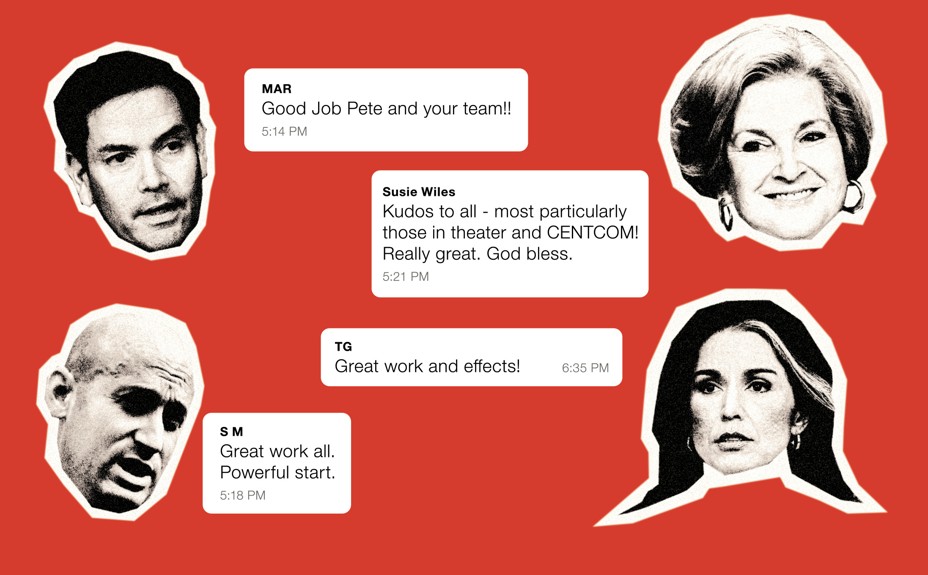
The colloquy came to a sudden end when the user “S M,” whom I took to be the Trump confidant Stephen Miller, wrote, “As I heard it, the president was clear: green light, but we soon make clear to Egypt and Europe what we expect in return.”
That was that. Hegseth wrote, “Agree,” and the dissident vice president said nothing. And then came the day of the Yemen strikes. At 11:44 a.m. on Saturday, March 15, I was at a supermarket—a Safeway in the Chevy Chase neighborhood of Washington, D.C.—when the following alert came in over Signal from Hegseth: “TEAM UPDATE.” What followed was information that, had it been seen by an enemy of the United States, could have been used to kill American military and intelligence personnel. Hegseth promised that Yemen would be attacked within two hours.
I’ve seen strange things in my career, but nothing quite like this. I stayed in my car in the Safeway parking lot and waited. I took screenshots of the chat and searched X and other platforms for news of U.S. military activity. Hegseth had said in the chat that the first detonations would be felt at 1:45 p.m. eastern time. At approximately 1:55 p.m., credible news reports started appearing about an attack.
In the chat, congratulations began to pour in. Waltz posted three emoji: a fist, an American flag, and fire. Steve Witkoff, Trump’s all-purpose, in-over-his-head global-conflict negotiator, responded with five emoji: two praying hands, a flexed bicep, and two American flags. Later, the Houthi-run Yemeni health ministry reported that at least 53 people had been killed in the attack (the number has not been confirmed independently). The Houthis are despicable terrorists, and in my opinion should be fought and defeated, but there was still something disturbing about the proliferation of emoji.
Illustration by Erik Carter. Sources: Kayla Bartkowski / Getty; Eric Lee / Bloomberg / Getty; Jabin Botsford / The Washington Post / Getty; Kevin Dietsch / Getty.
Proof that the chat was authentic forced me (and a growing number of advisers, sworn to secrecy) to make a choice. I was interested in exposing a security breach at the highest reaches of government; I was less interested in being accused of violating the Espionage Act. I would thus exit the chat later that same day. The Signal group would be alerted that I had left, so timing was important. That evening was the annual dinner of the Gridiron Club, at which Washington journalists host senior administration officials and members of Congress and make mainly mild fun of them from the stage. I heard that Waltz might be attending. I didn’t want the FBI raiding the dinner to seize my phone, so I waited until the end of the dinner to leave the chat. I spent the next hours awaiting recognition by the federal government that I was an apostate member of the “Houthi PC small group.”
But, nothing.
As a reporter, I was relieved; as a citizen, I was appalled by the violation of the first commandment of digital hygiene: Thou Shalt Know Who Is in Thy Group Chat.
The next week rushed by as we prepared the story for publication. I decided not to include some of the key operational details shared by Hegseth, Waltz, and Ratcliffe, the CIA director. I wanted to expose their incompetence without releasing information that could hurt American troops. Early on Monday, March 24, I wrote to Waltz and Hegseth on Signal (of course) and then others by email, asking for confirmation and comment. I would learn that my requests set off a scramble in the White House. The National Security Council called an emergency meeting in the Situation Room, where the mood, as participants later described it to me, was one of incredulousness and anger. According to people who participated in the meeting, Alex Wong, who was then the principal deputy national security adviser, briefed officials, but he didn’t have much information. The White House counsel, David Warrington, asked, slowly and repeatedly, “How. Did. This. Happen?”
To their credit, White House officials quickly responded to me and confirmed the authenticity of the chat, and we published our story. These officials publicly argued that nothing secret or sensitive had been disclosed in the chat, which was nonsense, though their argument was helped by my decision to keep actual operational details out of the story. It was my word against theirs.
There were two main worries in the White House that morning. The first: Who would tell the president? It is my understanding that Susie Wiles, the White House chief of staff, instructed Waltz to tell Trump. (Wiles, we would later learn, disliked Waltz, who treated her poorly.) The second worry was that Hegseth, who was then flying to Hawaii aboard the Pentagon’s “Doomsday” plane, would be unable to muster a mature reaction to the story. Over the course of the day, officials spoke with him and texted him repeatedly while he was in the air, pleading with him to respond to questions by saying only that no classified information had been disclosed.
Temperament is destiny, and Hegseth responded frantically and defensively. “You’re talking about a deceitful and highly discredited so-called journalist who’s made a profession of peddling hoaxes time and time again,” he told reporters when he landed. He was referring to my reporting, in 2020 and in 2024, that Trump had made various contemptible comments about American troops, including that soldiers who fell in war were “suckers” and “losers,” and that Trump had also said, “I need the kind of generals that Hitler had.” (Multiple sources confirmed that Trump had made these comments, including John Kelly, a former White House chief of staff and a retired Marine general.)
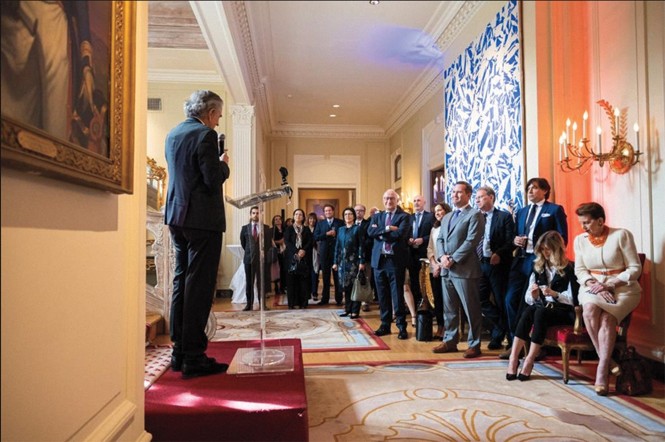
Former National Security Adviser Michael Waltz stands next to Jeffrey Goldberg at the French embassy in Washington, D.C., in 2021. (X / Bernard-Henri Lévy)
Waltz also responded in a juvenile manner, telling Fox News the next day that I am “the bottom scum of journalists. And I know him in the sense that he hates the president, but I don’t text him. He wasn’t on my phone, and we’re going to figure out how this happened.” Waltz went on to say, “Of course I didn’t see this loser in the group.” (I believe this is what is known as “projection.”) And he made a comment that provided material for a week’s worth of late-night comedy. In explaining how I may have been added to the chat, he said, “Well, if you have somebody else’s contact, then somehow it … gets sucked in. It gets sucked in.” (I recently learned that Wiles ordered Waltz to turn his phone over to Elon Musk—at the time a kind of one-man Genius Bar for White House officials—who reported back to Wiles that my phone number did not get “sucked in” to Waltz’s phone.) Waltz also denied ever having met me, which is not true.
The ad hominem campaign by Waltz, Hegseth, Gabbard, the CIA, and White House Press Secretary Karoline Leavitt, combined with the assertion that no classified information had been included in the chat, presented me with a dilemma. I knew, of course, that the information I’d seen on my phone would ordinarily be judged top secret by the military, and I knew that the White House lies were meant to undercut the credibility of this magazine. I simply could not understand why the administration was goading me into releasing the full message chain, which would show that I was correct in stating that the information was highly secret.
We devised a plan: My colleague Shane Harris, who covers the intelligence community, and I would speak with leaders of the relevant government agencies and ask them if they objected to the publication of the rest of the messages. This written statement, from Leavitt, illustrates the sophistication of the administration’s response: “As we have repeatedly stated, there was no classified information transmitted in the group chat,” she wrote. “However, as the CIA Director and National Security Advisor have both expressed today, that does not mean we encourage the release of the conversation. This was intended to be a an [sic] internal and private deliberation amongst high-level senior staff and sensitive information was discussed. So for those reason [sic]—yes, we object to the release.”
We published a follow-up story and included the operational messages from Hegseth and Waltz. Here is the key text from Hegseth: “TIME NOW (1144et): Weather is FAVORABLE. Just CONFIRMED w/CENTCOM we are a GO for mission launch.” Centcom, or Central Command, is the military’s combatant command for the Middle East. He continued:
“1215et: F-18s LAUNCH (1st strike package)”
“1345: ‘Trigger Based’ F-18 1st Strike Window Starts (Target Terrorist is @ his Known Location so SHOULD BE ON TIME)—also, Strike Drones Launch (MQ-9s)”
“1410: More F-18s LAUNCH (2nd strike package)”
“1415: Strike Drones on Target (THIS IS WHEN THE FIRST BOMBS WILL DEFINITELY DROP, pending earlier ‘Trigger Based’ targets)”
“1536: F-18 2nd Strike Starts—also, first sea-based Tomahawks launched.”
“MORE TO FOLLOW (per timeline)”
“We are currently clean on OPSEC.”
“Godspeed to our Warriors.”
It would have been more accurate to have written, “We are currently clean on OPSEC, except that I’m sending this information to the editor of The Atlantic.” To honestly believe that this information was not secret would require Hegseth to achieve Olympian levels of self-deception.
As all of this was happening, I was receiving messages from various military officials expressing disdain and anger that Hegseth refused to take responsibility. None of them went public with their outrage, however.
Other people did, including a modest number of Republicans. Senator Roger Wicker, the chair of the Senate Armed Services Committee, told reporters, “The information as published recently appears to me to be of such a sensitive nature that, based on my knowledge, I would have wanted it classified.” Wicker and his Democratic counterpart, Senator Jack Reed, asked for a Pentagon investigation. I doubted that this would occur, because the administration was dismantling the inspector-general system across the federal government. But an investigation was soon said to be under way.
Only two administration figures did not seem especially alarmed or defensive during the controversy. The first was the vice president, who, we would later learn, made one final joking addition to the “Houthi PC small group” chain late on the night after my first story appeared: “This chat’s kind of dead,” he wrote. “Anything going on?”
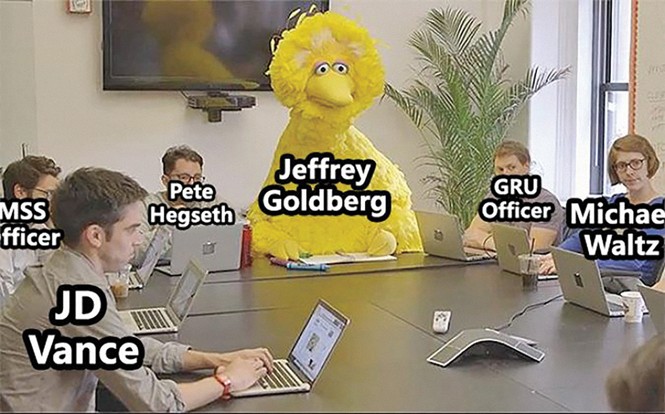
Signalgate became fodder for memes and late-night comedy. The Trump administration had violated the first commandment of digital hygiene: Thou Shalt Know Who Is in Thy Group Chat. (Bluesky / @kampfmitkette.bsky.social)
The other was the president himself.
I was worried that the Signal story would complicate already complicated efforts by my colleagues Ashley Parker and Michael Scherer to get an interview with Trump. But instead—and this was somewhat predictable to those of us who have paid close attention to Trump over the years—he not only granted them an interview, but invited me to participate. He could not resist the temptation to troll us along the way, however. Three hours before our scheduled visit to the Oval Office, he posted the following message on Truth Social:
Later today I will be meeting with, of all people, Jeffrey Goldberg, the Editor of The Atlantic, and the person responsible for many fictional stories about me, including the made-up HOAX on “Suckers and Losers” and, SignalGate, something he was somewhat more “successful” with. Jeffrey is bringing with him Michael Scherer and Ashley Parker, not exactly pro-Trump writers, either, to put it mildly! The story they are writing, they have told my representatives, will be entitled, “The Most Consequential President of this Century.” I am doing this interview out of curiosity, and as a competition with myself, just to see if it’s possible for The Atlantic to be “truthful.” Are they capable of writing a fair story on “TRUMP”? The way I look at it, what can be so bad—I WON!
When we entered the Oval Office, Trump said, “This will be very, very interesting. You think Biden would do this? I don’t think so.”
(He was correct.)
“Thanks for announcing the interview on Truth Social,” I said.
“I wanted to put a little extra pressure on you,” he said. “But at the same time, you’ll sell about five times more magazines.”
I asked him, in the course of the interview, what he meant by “I will be meeting with, of all people, Jeffrey Goldberg.”
“Oh, you like that? I had to do that,” he said. “I had to explain to people. That’s my way of explaining to people that you’re up here, because most people would say, ‘Why are you doing that?’ I’m doing that because there is a certain respect.”
“Are you saying that Signalgate was real?” I asked.
“Yeah, it was real. And I was gonna put in something else, but I didn’t have enough time.” This led me to ask, out of sheer curiosity, “How long does it take you to write these?”
“Not long,” he answered. “I go quickly as hell. You’d be amazed. You’d be impressed. And I like doing them myself. Sometimes I dictate them out, but I like doing them myself. What I’m saying is that it became a big story. You were successful, and it became a big story.”
Me: “But you’re not saying that it was successful in the sense that it exposed an operations-security problem that you have to fix?”
Trump: “No. What I’m saying is, it was successful in that you got it out very much to the public. You were able to get something out. It became a very big story.”
I then asked him directly if there were any other possible lessons to be learned from the Signal breach.
The president answered, “I think we learned: Maybe don’t use Signal, okay?”
Months went by. We heard, again and again, that the Defense Department’s inspector general would investigate, but nothing came of it. Finally, in December, the report was released. It found what had seemed obvious from the outset: that Hegseth’s use of Signal to discuss bombing Yemen could have exposed U.S. tactics and endangered troops.
“The Secretary sent information identifying the quantity and strike times of manned U.S. aircraft over hostile territory over an unapproved, unsecure network approximately 2 to 4 hours before the execution of those strikes,” the report reads. “If this information had fallen into the hands of U.S. adversaries, Houthi forces might have been able to counter U.S. forces or reposition personnel and assets to avoid planned U.S. strikes. Even though these events did not ultimately occur, the Secretary’s actions created a risk to operational security that could have resulted in failed U.S. mission objectives and potential harm to U.S. pilots.”
Rubble in Saada, Yemen, after a U.S. air strike. According to the Houthi-run Yemeni health ministry, the attacks discussed in the “Houthi PC small group” are believed to have left at least 53 people dead. (Naif Rahma / Reuters)
The report concluded, however, that because the secretary of defense possesses “original classification authority”—meaning he has the power to declassify secrets at will—he wasn’t technically in violation of any rules governing secrecy, only rules banning the use of private messaging apps for official Pentagon business.
Hegseth claimed that the report cleared him of all wrongdoing. “No classified information,” he posted on social media. “Total exoneration. Case closed. Houthis bombed into submission. Thank you for your attention to this IG report.”
He had not always been so forgiving when it came to matters of operational security. In 2016, at the height of the furor concerning Hillary Clinton’s email server, Hegseth, then a Fox News host, said, “How damaging is it to your ability to recruit or build allies with others when they are worried that our leaders may be exposing them because of their gross negligence or their recklessness in handling information?”
The U.S. is now engaged in another bombing campaign, larger and more sustained than the strikes on the Houthis. Every day, hundreds of aviators are ordered into the airspace above Iran. Their lives depend on the operational security that the military’s culture of accountability is designed to safeguard.
The Department of Defense employs nearly 3 million people, uniformed and civilian. All are subject to rules and regulations governing many aspects of their behavior. Any one of them would have faced serious consequences for announcing, on an insecure messaging app, that the U.S. was about to send its pilots over enemy territory.
All except one.
*Lead-image sources: Mandel Ngan / AFP / Getty; Tom Williams / CQ Roll Call / Getty; Andrew Harnik / AFP / Getty.
This article appears in the April 2026 print edition with the headline “The Unbearable Lightness of Signalgate.”
In 1825,Life of William Grimes, the Runaway Slave, Written by Himself became the first known fugitive-slave narrative in American history. Although earlier autobiographical accounts of slavery had been published in England, the genre wouldn’t fully flourish in the United States until the antislavery movement of the 1830s to 1860s, when such narratives became powerful tools of moral persuasion, exposing the brutality of bondage while asserting the writer’s humanity, intellect, and will. William Grimes wrote before that moment, introducing a distinctly American voice shaped by the horrors of enslavement in the South and the precariousness of freedom in the North. What he published was more than a memoir—it was an indictment of the contradictions that had been central to the American experiment since the Revolution itself.
For 30 years, I have been researching the life and legacy of Grimes, who was my third great-grandfather. In May 2024, during my final week as a research fellow at Yale’s Beinecke Library, I made a trip to the Boston Athenaeum to see a copy of his book that had been housed there since 1849 and remained unexamined by scholars for 175 years. This copy, I’d learned, had been addressed to President John Quincy Adams. I had no way of knowing whether the sixth president had read Grimes’s narrative. But discovering the fact that Grimes had wanted him to see it moved me in ways I hadn’t anticipated.
Grimes’s story opens with bitter irony:
I was born in the year 1784 in J_____, County of King George, Virginia, in a land boasting its freedom and under a government whose motto is Liberty and Equality. I was yet born a slave.
“In all the Slave States,” Grimes wrote, “the children follow the condition of their mother.” Though his father, Benjamin Grymes Jr., was a wealthy white Virginia planter, William remained enslaved like his mother—legally the property of a man he calls Dr. Stuart, Grymes’s neighbor. He recalled carrying newspapers to his father, who would speak and laugh with him and send him to the kitchen for something to eat. Whatever endearment young William may have felt, Benjamin Grymes neither owned, purchased, nor freed his enslaved son.
At 10 years old, William was sold by Dr. Stuart to Colonel William Thornton, his brother-in-law, and sent to a distant plantation in what is now Rappahannock County. He grew up, as he later wrote, friendless and motherless, shaped early by violence and hunger. Inside the house, the head servant and seamstress sabotaged him to advance her own child; in the fields, overseers beat him for the slightest offense. When he was 12 or 13, he ran away to escape a brutal overseer, hiding in a hollow log for three days until he gave himself up, deciding that he “might as well be whipped to death as to starve.” Hardened by slavery, he grew up defiant.
He later implied that he could not be governed in the way that slavery was intended, writing that he had “too much sense and feeling to be a slave.” He said that he carried “too much of the blood of my father,” a former “Life Guard” to George Washington, “whose spirit feared nothing.” Over time, Grimes passed through the hands of 10 enslavers—from Dr. Stuart to Colonel Thornton and two of his sons, then to six interconnected businessmen in Savannah, Georgia.
In 1815, opportunity—not planning—opened a path to freedom. Left to hire out his time while his enslaver vacationed in Bermuda, Grimes went to the Savannah harbor seeking work. With discreet help from Black “Yankee” sailors who befriended him, he hid among cotton bales in the hold of a brig called the Casket as it set course for Quarantine Ground, off Staten Island. Evading inspection, the sailors helped him reach a packet boat bound for New York City. From there, Grimes walked some 80 miles to New Haven, Connecticut.
For nearly a decade, he lived in the shadows—always vigilant, always at risk, yet determined to build a life. He was a servant at Yale College; he cut hair, and eventually established a barbering business in Litchfield; bought property; married Clarissa Caesar; and started a family. Barbering—a Black man’s trade—gave him access to learned men: Yale students, legal minds at Tapping Reeve’s law school in Litchfield, and political leaders, including Connecticut Governor Oliver Wolcott Jr.
Grimes moved regularly through spaces where ideas circulated and power was shaped. All the while, he lived with the knowledge that his freedom could be revoked at any moment. In September 1823, that fear became reality when his former enslaver F. H. Welman, aided by Savannah business partners, located him. Facing the prospect of seizure and return to the South, Grimes offered his small, debt-burdened house—the extent of his property—to remain with his wife and children.
Negotiations stretched across Connecticut, Georgia, New York, and the District of Columbia. Welman valued Grimes at $800 but agreed to accept $500. Yet even that reduced sum was beyond Grimes’s immediate reach.
Letters preserved at the Litchfield Historical Society point to an initial arrangement born of necessity: a down payment, likely from the sale of his home, followed by installments extending nearly a year. The final terms under which Grimes succeeded in purchasing his own body remain unknown, although it is certain that he lost his home in the process. Until the final payment was made, his freedom was provisional; re-enslavement was an ever-present threat.
At the Athenaeum, I was led to a reading table and handed Tracts Volume IV—a bound collection of pamphlets once owned by President John Quincy Adams and donated to the library in 1849 by his son Charles Francis Adams. Inside were sermons, political tracts, and educational booklets. Then I saw it. A small handwritten note lay tucked inside Life of William Grimes, resting directly atop the title page. The penmanship was confident, self-assured; the signature unmistakable: Wm. Grimes. A dark inkblot marked the note—his hand on the page two centuries ago:
Relying on your Excellency’s generosity, the Author presents this pamphlet to the President of the United States, Stamford, CT; May 15, 1826. Wm. Grimes.
To understand the full weight of that ink, I needed to understand what had led up to this moment.
In 1824, the celebrated French aristocrat General Lafayette—a hero of the American Revolution—returned to the United States at President James Monroe’s invitation for a sweeping farewell tour designed to rekindle patriotic devotion in a new generation. Wherever Lafayette traveled, parades and speeches proclaimed the United States the world’s beacon of liberty. On August 12, the general was greeted in New Haven with patriotic fervor. Governor Wolcott was there to welcome him.
Whether or not Grimes, the governor’s barber, attended the festivities himself, he was close enough to the celebrations to feel the pride of liberty collide with his reality as he worked toward purchasing his own freedom. We cannot know precisely when he began writing, but his book’s preface is dated October 1, 1824, less than two months after Lafayette’s visit. By January 1825, Grimes had deposited the completed manuscript with the clerk of the District of Connecticut.
Two months later, on March 4, 1825, the newly inaugurated President John Quincy Adams made reference to a national “jubilee” to mark the 50th anniversary of the formation of the United States. His speech read like a progress report on the republic’s first half century. Regarding slavery, however, Adams balanced his own antislavery convictions against the proslavery stance of his vice president, John C. Calhoun. The new president trod carefully, acknowledging only obliquely the legal end of the transatlantic slave trade in 1808.
Grimes surely would have read Adams’s inaugural speech. He understood well that the written word was power—that books and newspapers shaped public thought and conferred authority. His life reveals how charged literacy was in the world he navigated. As a teenager, he was brutally beaten for carving letters into an outdoor oven while the mortar was still wet. In Savannah, he was hired out to the family of P. D. Woolhopter, a co-founder of Savannah’s Columbian Museum, a Federalist newspaper. As a fugitive in New Haven, he boldly advertised his barbering business in the Connecticut Herald. And in early August 1825, he placed an ad for his book, addressed “To the Public,” in the Connecticut Journal, printing the gripping preface in full. His advertisement ended with a drumbeat: “For sale at the Bookstores in this city.” In 1825, for a formerly enslaved man to publicly claim authorship and sell his book in white-owned bookstores was to plant a flag of freedom in hostile ground. It declared: I am here. I will not be hidden or silenced.
In the context of the approaching national milestone—before parades, fireworks, and soaring speeches saluted the nation’s 50th anniversary—Grimes’s decision to send the book to Adams with a formal note seemed like a carefully aimed stone at the glass of America’s triumphal story. When I returned to the opening line of his narrative, I saw it differently—what once appeared to be a simple beginning now commanded deeper scrutiny: I was born in the year 1784 in J_____.
For years, I’d assumed the J stood for a place. But what if it meant January? On January 14, 1784, the Treaty of Paris was ratified—the nation’s first legal breath of freedom. Grimes later admitted that he could not tell his wife his true age; most enslaved people never knew their birth year, let alone their full date of birth. What if, by tying himself to the historic month of January 1784, he had been deliberately aligning his life with the birth of the republic? Was this part of the message he wanted the president to absorb?
The pages that followed Grimes’s polite presidential dedication—Relying on your Excellency’s generosity—shattered any veneer of civility, exposing the reality of Grimes’s life as an enslaved man from the South and the fragility of survival in the so-called free North. Grimes’s narrative is raw and unsparing, laying bare not only relentless physical violence but also psychological trauma with no time or refuge to heal. He closes his book with a passage that strips jubilee rhetoric of all deception:
If it were not for the stripes on my back which were made while I was a slave, I would in my will leave my skin as a legacy to the government, desiring that it might be taken off and made into parchment, and then bind the constitution of glorious, happy and free America. Let the skin of an American slave bind the charter of American Liberty!
If Adams read those words in 1826, he would have encountered a direct challenge to his own language of triumph. Adams, a man who believed in moral law but often deferred action, would have been forced to confront slavery not as a distant policy problem but as a constitutional failure written in human flesh. Perhaps, I imagined, Grimes’s words had managed, however fleetingly, to expose the gulf between the nation’s self-congratulation at 50 years and the violence required to sustain its freedom.
Adams would later begin to challenge that contradiction more openly. By the late 1830s, freed from presidential constraint, he was battling the congressional gag rule that sought to silence any mention of slavery, and in 1841 he stood before the Supreme Court to defend the Amistad captives and insist on their right to freedom.
We will likely never know whether Adams read Grimes’s book. But it was not discarded. It was passed on to his son, and it was trimmed and bound, preserved. Something in it had mattered—and still does today.
When you buy a book using a link on this page, we receive a commission. Thank you for supporting The Atlantic.
 Log in