827 stories
·
0 followers

September Reading List

1 Comment

Here’s my reading list for September. This is last month’s list and you can follow it back from there.

PROFESSIONAL READING:

  1. Erika Rappaport, A Thirst for Empire: How Tea Shaped the Modern World (Princeton, 2017). This is one of those big single product books that tells a story of empire and globalization, British style of course. It’s good and pretty readable. These books have a bit of sameness to them, in part because they often rely, as this does, on fairly rote analysis of advertising. But this is also a better and more serious book than many others, centering the relationship between taste and state-making.
  2. Francis MacDonnell, Policing Show Business: J. Edgar Hoover, the Hollywood Blacklist, and Cold War Movies (Kansas, 2025). We usually think of the Blacklist as something coming out of Congress, but MacDonnell shows how J. Edgar Hoover was enormously influential in targeting people, often based on his old personal grievances. FBI agents were often incompetent by their own standards in investigating various people, not to mention completely incompetent at analyzing what artists were even doing, often ruining people’s lives along the way. It got weird along the way. Adolphe Menjou was such an extremist that even Hoover thought he was crazy, while Hoover pissed off Walt Disney, leading to the cartoonist, a conservative himself, to spoof the FBI in late era cartoons.
  3. William G. Thomas III, A Question of Freedom: The Families Who Challenged Slavery from the Nation’s Founding to the Civil War (Yale, 2020). A history of the Maryland lawsuits over freedom filed by people with ancestral claims to freedom. forcing that state to tighten its rules for freedom. This is part of a growing historiography over how slaves could sometimes enter the legal system to advocate for themselves, despite the incredible restrictions they faced. This is also a family history since Thomas’ own family were among the sued slaveholders. That certainly gives it a different dimension than your average history and really, for the topic of lawsuits, this is quite well written.
  4. Matthew Dallek, Birchers: How the John Birch Society Radicalized the American Right (Basic, 2023). Dallek makes the fairly obvious but compelling case that the modern Republican Party is effectively the John Birch Society. This was published in 2023. Things have not improved since. If you need an overview of the JBS, this works very well.
  5. Stevie Ruiz, Stewards of the Land: Race and Reclaiming Environmental Labor in the American West (North Carolina, 2026). This is a very bad book that I guess is what happens when the kinds of methods that come out of Ethnic Studies are applied to environmental history. It’s not that this person doesn’t have good points. In fact, there are several quite illuminating insights and I learned some stuff. But there are also assertions about scholars that I don’t think are accurate, he seems to fighting with constructions of blindness toward racist pasts that exist in the general public but which he incorrectly transfers to scholars who have in fact paid attention to these questions, and factual errors. And when you say that environmental historians pay more attention to logging than agriculture because a logged forest can still be wilderness, well, that’s in fact definitionally untrue and really makes me question the entire process. I was supposed to review this professionally. I begged off because I didn’t want to write what I really wanted to say since this is the kind of guy who would take a bad review by a white guy and just call me racist for writing it. So I will say it outside a professional journal instead. One other thing–I, obviously, have no problem with activist scholarship. But the scholarship still has to be accurate, not riding on being a righteous warrior. Robin D.G. Kelley never made that mistake. Nor did Gloria Anzaldua. Nor a lot of other scholars of color who changed the world through their work.
  6. Deborah Baker, Charlottesville: An American Story (Graywolf, 2025). A pretty good overview of the rise of the racist far right and the local activists resisting that, leading to the United the Right rally in Charlottesville in 2017. Baker has all the footage, interviews, and everything else she could manage to get. And it’s a lot. I still wonder a bit about books like this in terms of anything quoted that doesn’t just come from a preexisting record. That’s not to slag on this book, which is worthy if you want to read about the terribleness that, at least if you are me, you probably already know enough about. I just wonder how books like this are put together and what the standards are in creating dialogue that seems to work. Solid book in any case.
  7. Jordan Thomas, When It All Burns: Fighting Fire in a Transformed World (Riverhead, 2025). A very fine book by an anthropologist who also spent a year as a hotshot fire fighter in California. Thomas both describes the appeals of the hypermasculine culture of men doing incredibly dangerous work for any number of reasons but need to stay together to survive and the reality of what Americans have done to the forest that create these horrible fires. Well worth your time, also very readable.
  8. Jessica Marie Johnson, Wicked Flesh: Black Women, Intimacy, and Freedom in the Atlantic World (Pennsylvania, 2022). This much lauded book deserves its accolades. Not only is it a fantastic history of black women creating processes of freedom (and it really is always a process, not an either/or, in part because they are women) in incredibly difficult circumstances from west Africa to New Orleans, the archival work and insights are extremely impressive. It’s also a hugely important addition to the growing literature of family and intimacy in slavery. It’s a book that is geared for a scholarly audience, but if you want to read some of the first rate work that historians produce these days, this would be a fine example for you.

FICTION/LITERARY NON-FICTION

  1. Ruth McKenney, Industrial Valley. This is a little known 1939 industrial novel. McKenney was a rich woman from Ohio who became a communist in the 30s and she details the rubber strikes in Akron that helped usher in the CIO. Most of it is done in snippets, often drawn from the news, that demonstrated the world she really knew–that of the rich Ohioans who hated the idea of organized workers and who were just so determined that the economic gods destined them to remain on top. Her real knowledge of the workers wasn’t so great and so those parts are a bit less well-tuned. Stilk, the story of the strike victory is real enough (though somewhat overstated since the rubber workers never really gained that much power in the Akron factories) and the only time it gets ridiculous is a short section near the end where the CP organizers tell the workers that those who are saying they shouldn’t sign the deal are Trotskyites and OMG.
  2. Walker Percy, The Moviegoer. I know many think of this 1961 novel as an American classic. But I really struggled with it. It’s such a midcentury document, one of the existential crisis of a rich guy who just can’t figure out what it all means. Dude, life means nothing, just get on with it. I felt very British reading this and was rolling my eyes a bit at all the navel gazing.
  3. John Brickerhoff Jackson, A Sense of Place, a Sense of Time. I covered Jackson’s grave back in the spring and it made me want to read this classic book of essays again, one that really influenced me. Jackson was the bard of vernacular architecture–people creating landscapes how they wanted to. You might not agree with his discussion of trailer parks and cars in yards and his glorification of the road (which he did very much love), but he was a great writer of connecting nature and humans in ways that do not romanticize nature. Maybe they do romanticize humans a bit, but in environmental writing, that’s a useful corrective. Mobility is the theme of the 20th century and all that meant on the landscape. No one thought through this more effectively than Jackson.
  4. Gunter Grass, Local Anaesthetic. I’ve never been much of a fan of Grass, but I picked up this early novel of his, from 1969. It picks up on his theme of Germans dealing or not dealing with the Nazi past and the dissatisfaction of the contemporary youth. The first half of the book can be very hard to follow–it’s very impressionistic and most of it is about a teacher who is at the dentist and starts engaging with a crisis–he has a student who wants to burn his own dog alive as a political statement. He has a fellow teacher who he likes a lot and she likes him but she has a lot of guilt from her strong support of the Nazis when she was a girl during the war who got mobilized toward the end of the war. The second half becomes a little more of a followable narrative that revolves in part about everyone trying to figure out how to convince the student not to do that horrible deed. This novel is now almost completely forgotten, but it and its fairly obvious metaphors for the problems of late 60s West Germany was really lauded at the time and if not The Tin Drum, added a lot to his reputation.
  5. Rachel Kushner, Creation Lake. I loved this. Kushner, clearly inspired by the late 60s/early 70s political noir of Jean-Patrick Manchette, tells the story of a woman self-named Sadie Smith, an industrial spy who works for shady corporations to frame environmentalists and other leftists for crimes. She is after a communal movement in southern France trying to stop a big agriculture scheme that the government wants but which would displace the traditional people of the area. The commune is based on a 60s radical organizing it and his old colleague who is a philosopher nearby but never seen who she has hacked the email for. She begins to engage in the anti-modernist ideas of the philosopher while also infiltrating the group and if she doesn’t exactly come to a transformative moment, she begins to find new meaning to a lost life through his ideas. If you explain the whole plot, it honestly sounds kind of dumb, but the intellectual world and internal understanding of Sadie that Kushner creates is really genius stuff. It’s also pretty funny as Kushner can be mighty cutting.
  6. Rabih Alameddine, The True True Story of Raja the Gullible (and His Mother). My first exposure to Alameddine, I thought this story of a gay man and his mother during the tumultuous times of the last half-cnetury in Lebanon to be a fun, excellent read. He’s gone through a lot, including a long middle section of him being kidnapped and locked up as the civil war broke out, where he first has sex with a man, his captor, and then the trauma that takes place when he escapes while wearing a dress. But it’s also a funny story about an aging cranky gay guy and his out of control mom who everyone loves and they yell at each other all the time but love each other very much too. There are also cats. And also Alameddine thinks Dostoevsky is pretentious bullshit and says so. How does one survive such a world? Luck in part, but also a special kind of resilience and maybe a good mom too.

This is your monthly book thread.

The post September Reading List appeared first on Lawyers, Guns & Money.

Read the whole story
deebee
7 hours ago
reply
Hard pass
America City, America
Share this story
Delete

Why Are Billionaires So Liberal?

1 Comment

Ever wonder why so many super-rich people are liberals?

George Soros, Reid Hoffman, Reed Hastings, Michael Bloomberg, Bill Gates, Tom Steyer...the list of progressive billionaires is a long one.

It doesn't make any sense, right? Rich people are supposed to be Republicans! You know, hanging at their country clubs, making fun of everyone else.

And yet, many of them...

...advocate for higher taxes - on themselves. 

...are outspoken climate or AI doomers, advocating for anti-growth policies.

...give financial and moral support to the very progressive forces that are trying to tear down western civilization - the very same civilization that made their riches possible

Why would people who benefit so much from the existing system support policies that might reduce their own fortunes? 

It doesn’t make sense.

Or does it?

It’s all about incentives. 

Past a certain level of wealth, the marginal utility of, say, an additional billion dollars, decreases. Once you have one mega yacht, do you really need another? How many planes or mansions can you really use? 

Eventually, you run out of things to buy, and wealth becomes numbers on a piece of paper. Money stops being the only reward that matters. 

Esteem, influence, and a lasting legacy become even higher priorities. 

Complicating matters, though, is that vast wealth begets higher public visibility and scrutiny. Your reputation spills into the public domain. The media, in particular, begin to notice you. That can be problematic.

You've arrived at what I'll call the "legacy crossover," the point at which you stand to gain more from public esteem than from protecting the next increment of wealth.

The legacy crossover recognizes a new incentive: burnishing one's reputation.

The media, for their part, are not inclined to help you, particularly if your money is self-made.

You do things. You make things. They do not, and they resent you for it. And since they have the platform they control the narrative.

You need to wrest it from them, or at least steer it in a new direction.

But how?

By letting them see a new you, a enlightened you, a virtuous you. One who has grown, and who now embraces the same, globalist-tinged, values as they.

So, you make a public display of your benevolence. You sign up for the Giving Pledge, like Michael Bloomberg. You tell everyone you should pay more in taxes like Tom Steyer. You speak in solemn tones about the dangers of AI or global warming like Bill Gates.

To be fair, some of these people may sincerely believe every word of it; sincerity and an incentive to be seen believing it can coexist.

The cost, assuming any of your new policy positions are actually enacted, is just some numbers on that piece of paper. 

The benefit? 

Glowing notices. Public admiration. A reputation that will outlast you. Obituaries that will someday sing your praises. 

For most, it's an easy trade-off.


Read the whole story
deebee
3 days ago
reply
No one stupid enough to follow this is also smart enough to use the internet. This is bathroom wall material
America City, America
Share this story
Delete

Remember the MAGA vibe shift?

1 Comment

There’s a reason that Trump is so sweatily desperate to suppress the midterm elections that even John Roberts finds it a little excessive. And it’s this kind of polling:

With fewer than 50 days until the midterms, Democrats have developed a clear advantage over Republicans as the president has lost the public’s trust on the economy, according to a new national poll from The New York Times and Siena University.

President Trump’s lingering unpopularity and intense frustration over his management of cost-of-living issues, in particular, have deepened Republican vulnerabilities as Democrats push to win control of both the House and Senate.

Likely voters favored Democratic candidates over Republicans by close to 9 percentage points in their congressional district — a metric that is closely watched by both parties as a leading indicator of political momentum.

Mr. Trump’s approval rating continued to languish at 38 percent among likely voters, essentially unchanged from the lows it sank to after he went to war with Iran. A majority of voters disapproved of Mr. Trump’s handling of every major issue included in the poll: the economy, immigration, tariffs, the war and, especially, the cost of living.

And voters said they trusted Democrats more than Republicans on not just health care and foreign wars but also on the two issues that powered Mr. Trump’s 2024 victory: immigration and the economy.

Some of this (especially on immigration) is class thermostatic reaction to incumbent overreaching, but Trump has actively made things worse and hence a backlash larger than the typical reaction against the in-party. The Iran War in particular is one of the most obvious political blunders I’ve ever seen in addition to being a huge strategic and tactical one.

I’m guessing that it might be a while before we get another “why is Trump so smashingly popular with, uh, other people” emergency opinion panel.

The post Remember the MAGA vibe shift? appeared first on Lawyers, Guns & Money.

Read the whole story
deebee
17 days ago
reply
38% seems shockingly high
America City, America
Share this story
Delete

Trump lackeys threaten to shutter Kennedy Center unless it can be illegally turned into a personal monument to the person responsible for destroying it

1 Comment

A very MAGA story:

Leaders of the John F. Kennedy Center for the Performing Arts, installed by President Donald Trump, say the center is on the brink of bankruptcy and argue that putting the president’sname on its facade — and thus ensuring his fundraising efforts — may be the only way to avoid imminent and “certain fiscal collapse,” according to documents obtained by The Washington Post.

The bleak assessment is laid out in a 57-page packet distributed to the center’s board of trustees ahead of a special meeting Tuesday, when the Trump-led board is scheduled to consider two resolutions aimed at addressing twin crises confronting the national performing arts center: one financial, the other physical. Center officials say they could be unable to make payroll or pay routine maintenance contracts “within a matter of weeks” and argue that publicly recognizing Trump could secure his help raising enough money to keep the institution afloat.

Center officials are also recommending that the board close its main building immediately, warning that remaining open would endanger lives. Board approval, which seems likely, means the center could close as early as Tuesday.

The presentation makes clear that Trump’s support hinges on getting public credit for his involvement. The financial resolution says Trump has offered to “raise the necessary funds to keep the Center from bankruptcy” while the building undergoes a sweeping renovation. But it says Trump is unlikely to provide “fundamental oversight” of that project or lead a financial rescue without “appropriate recognition” of his role.

Together, the two proposals represent a remarkable new phase in Trump’s takeover of the Kennedy Center, which has been engulfed by financial turmoil, leadership upheaval and litigation since he installed himself as chairman last year. Trump and his allies have repeatedly portrayed his leadership — and his name — as essential to rescuing the institution, even as ticket sales and fundraising have plummeted under their stewardship.

Trustees are being asked to choose among 10 texts that could be placed on the building’s exterior beneath its name, including one reading: “Renovation Restoration and Endowment overseen by President Donald J. Trump and the Trump Kennedy Center Fund.”

It’s far from Trump’s most important abuse of power, but between the illegality, the self-aggrandizement, and the mob capo logic it’s among the most illustrative.

On the soft regime-aligned side, enjoy this argument from Megan McArdle about how it was wrong for people to boycott the Kennedy Center in light of the Trump takeover, because Trump’s amorality meant that he couldn’t be persuaded, so people had no choice but to go along and keep buying tickets to Lee Greenwood Sings the Songs of Toby Keith or whatever else was being put on by Trump’s goons. Apparently Kennedy Center patrons did find this persuasive — one thing about Trump 2.0 is that it cleanly separates people who understand how to respond to a shakedown and people who don’t.

The post Trump lackeys threaten to shutter Kennedy Center unless it can be illegally turned into a personal monument to the person responsible for destroying it appeared first on Lawyers, Guns & Money.

Read the whole story
deebee
19 days ago
reply
Knock it down. Far fewer than 99/100 Americans will never see the Kennedy center production of Chitty Chitty Bang Bang or the Four Tops. Call his bluff, we don’t owe the Kennedy’s anything more at this point.
America City, America
Share this story
Delete

The Mad King is coming to London

1 Comment

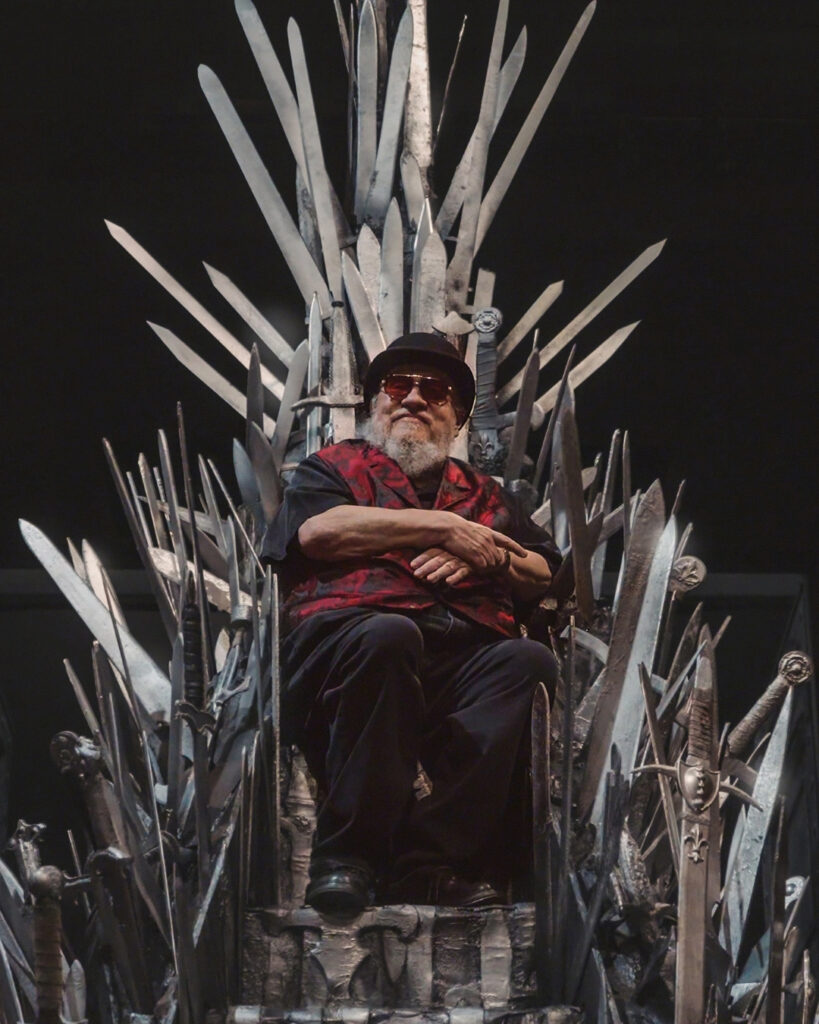
I had a splendid time in Stratford upon Avon for the premier of Duncan Macmillan and Dominic Cooke’s epic new stage production of Game of Thrones: The Mad King. And furthermore I’m thrilled to announce that the production will be moving on to London to share the experience with a wider audience.

New venue and premiere dates will be announced in due course, and if you would like to hear about new information feel free to sign-up at:

www.gameofthronesonstage.com

It promises to be an exhilarating journey.


Read the whole story
deebee
28 days ago
reply
Finally the news we’ve all been waiting for
America City, America
Share this story
Delete

On nominating women and non-white people for president

1 Comment

This is a meta-comment on Erik’s post and the subsequent thread on AOC possibly running for president in 2028.

It may be that in general victory has a thousand fathers while defeat is an orphan, but pretty much the opposite holds when it comes to punditry, amateur or professional. Political obsessives love to obsess about nothing so much as exactly why their party lost an election, especially a presidential election, and this tic expresses itself in what I find to be a very annoying way, which is this: Everyone presents their seat of the pants explanation as if it were a law of thermodynamics.

Example: Clinton and Harris lost to Trump because they are women and in the latter case a woman of color. This assertion, which is usually treated by those who make it as a self-evident fact, is basically just a guess, and not a very plausible one in my view. The reason its so superficially plausible is that it depends on the simple formula that since there’s a whole lot of racism and misogyny in American culture, a woman who loses an election to a man, and especially a non-white woman who loses to a white man, has lost because of all the racism and misogyny. It’s superficially plausible, but it’s also extremely superficial, period, because:

(1) The political science data suggest strongly that being a woman is not, all other things being equal, a disadvantage for candidates running against men. Now you can always say the presidency is different, but the evidence against this is that Clinton got three million more votes than Trump and lost (barely) on a freak EC distribution, and, when you take the massively anti-incumbent atmosphere in 2024 everywhere around the world into account, Harris actually did very well, losing one of the closer presidential elections in US history. So you have a sample of two, which by itself is very little meaning, and the evidence from that sample is at best very equivocal in regard to the hypothesis that gender and race were the decisive factors against the two candidates.

(2) Without re-litigating the whole thing I would bet all my LoomCoin and also a bunch of real money that Biden would have done MUCH worse than Harris, even without the catastrophe of the debate. Polls even from early in the cycle consistently indicated that the vast majority of DEMOCRATS didn’t want him to run again, for reasons that in retrospect are incredibly obvious, ESPECIALLY in a radically anti-incumbent context. The point here is this: if the debate hadn’t happened, or happened in October when it was too late to do anything about it, or hadn’t been a disaster, Biden would still have lost, by a lot, and I’ll bet all that LoomCoin on another proposition as well, which is all the people who are so certain that Harris lost because she was a woman POC would be saying that of course Biden got killed, who the hell thinks that the right strategy for Democrats in 2024 (a party of women and POC) was to run a 117-year-old white guy who might as well have had ESTABLISHMENT tattooed on his forehead? “Obviously” the Democrats’ only chance would have been to run a young charismatic woman of color, like oh I don’t know . . . AOC.

See how easy it is to play the counterfactual game?

(3) Yes some people are going to vote against a candidate because she’s a woman. We have a name for such voters: Republicans. The same holds for non-white candidates. Yes this is hyperbole: voters do exist who would have voted for the Democrat but for their racism/misogyny. Nevertheless although I would hate to give David Broder and Cokie Roberts heart attacks, in the year 2026 the Republican party is now the all but official home for racists and misogynists, and — here’s the key point — some people who otherwise wouldn ‘t vote at all, or would vote for a not obviously insane “moderate” Republican — like Donald Trump in 2016, when he was a “moderate” in the eyes of moron swing voters and reactionary centrists but I repeat myself — will vote for the Democrat if she’a a woman, and/or a woman of color. Because there are huge numbers of people in America who would desperately like to see a woman and especially a woman of color as president for extremely legitimate reasons. Energizing those people to at a minimum get out and vote, and ideally to be deeply invested in working toward electing that person, is extremely important. Side note: AFAICT the main evidence for Obama being some sort of transcendent generational political talent, as is so often claimed, is that a black man named Barack Hussein Obama got himself elected president in America. But this is question begging, because it assumes Obama’s race and “foreign/terroristic”-sounding name hurt him in his elections rather than helped him, and for all the reasons laid out in this post that’s completely unclear to put it mildly.

(4) Now, does the energizing the base component of nominating a woman/woman of color cancel out or more than compensate for the racism/misogyny effect? Guess what, nobody knows, because these things are complicated. But I would consider it a huge positive for AOC, or someone like her, to be elected president rather than Generic White Guy Flavor of the Month (hi Gavin), or even the more exotic models in the same genre, like Ossoff and Buttigieg. So unless somebody can produce some sort of actual EVIDENCE that being a woman and/or a POC is an actual negative for a Democratic presidential candidate, I’m going to support AOC, should she choose to run, for all the obvious reasons why it would be fantastic for her to be president.

(5) Some further complications: Is it a net positive that AOC is, to put it indelicately, hot? (OK Washington hot but still). I would like to think so, but again these things are always complex. Some people, lets call them men, are going to vote for AOC because of their boners, but some people will vote against her BECAUSE she’s very conventionally attractive. Plenty of social science indicates conventionally attractive women can have problems getting taken seriously in high status positions, because of the assumption that pretty women are dumb and got where they are only because of their looks. Misogyny is real complicated in other words, just like racism. Similarly, will the fact that AOC is so young help her or hurt her on net? Again, who knows? We don’t like candidates to be too old, obviously, especially after the recent series of unfortunate events, but we don’t want them to be too young, either, because inexperience is bad and scary, especially in a president, although not as scary as actual dementia as we are learning every day. We want them to be just right. How old is that? Science says 47 years and seven months* but you can’t have everything.

(6) Finally I want to address the issue of AOC being too left. What’s funny about this is you know who is too left for the kind of people who are influenced by the right wing scream machine? Joe Biden, that’s who. The thing about the Republican party having turned into an unhinged fascism loving machine is that “too left” is almost meaningless in American political discourse at this point. Who exactly is NOT going to vote for the Democrat is in 2028 against Trump or Crypto-Trump because the candidate is “too left?” Yes such people exist, as I’m only too well aware — I have a whole theory, you’ve probably never heard of it — but such people by definition are moronic random number generators whose voting preferences are so completely confused and irrational that trying to pick a candidate that will appeal to them is like trying to select a sonnet that will appeal to a golden retriever.

Which is all to say that I’m all in on the idea of AOC in 2028, although ultimately I’m of course completely 100% behind anybody the Democratic party might nominate because come on. But I see no reason NOT to support AOC’s candidacy, should it manifest, and most especially I consider her gender and race/ethnicity to be huge positives for me personally, while being essentially irrelevant or close to it for purely pragmatic reasons of electability, because of the complexity of the various countervailing factors. In other words, why the hell not?

*Joke

The post On nominating women and non-white people for president appeared first on Lawyers, Guns & Money.

Read the whole story
deebee
31 days ago
reply
Authenticity is an ice pick in a knife fightt
America City, America
Share this story
Delete
Next Page of Stories